
The plumber clears your drain and the water runs freely again. A few months later the toilet starts gurgling and the same blockage is back. By the third visit, most people want to know what is going on underground.
A CCTV drain inspection answers that by sending a camera into the pipe, so the cause can be seen rather than guessed. This guide covers what the footage can show, from cracks and leaks to tree roots, what each finding may mean, and what a camera cannot tell you.
What Can a CCTV Drain Inspection Reveal?
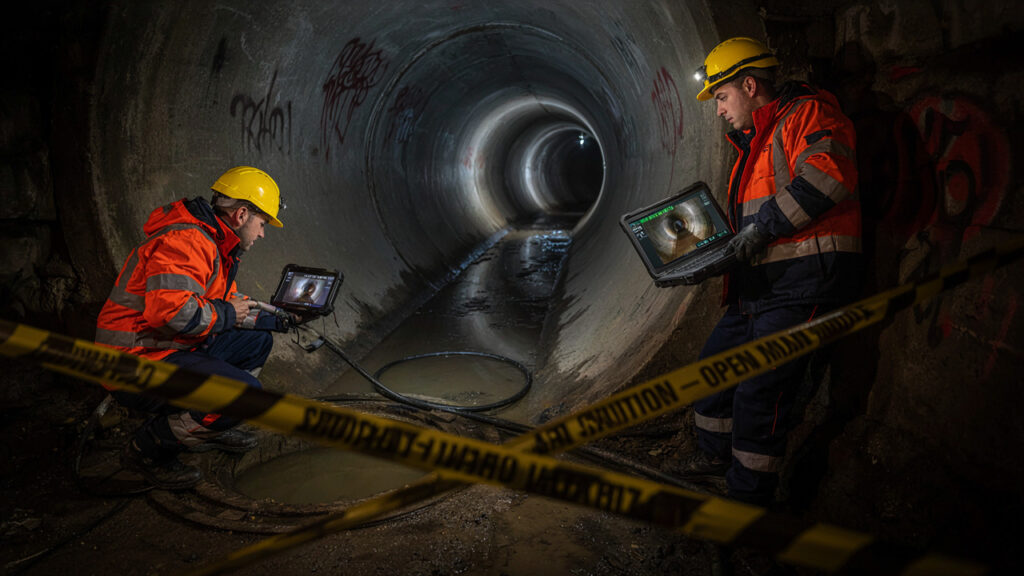
A CCTV drain inspection is a camera survey of an underground sewer or stormwater pipe. A waterproof camera on a flexible rod travels along the pipe and sends live video to a monitor. Most CCTV drain inspection findings fall into a few groups: cracks, water entering through joints, tree roots, displaced joints, sagging sections, corrosion or deposits, and collapse.
The camera shows the inside of the pipe in the sections it can reach. It does not repair anything, and it cannot always prove where a leak comes from.
Key takeaways
- A camera shows the pipe’s condition. It cannot measure overall strength or confirm every leak.
- Roots enter through existing cracks and open joints. Cutting them out clears the blockage and leaves the damage behind.
- Deposits, standing water or a collapse can stop the camera, so a good report states what was not inspected.
- Not every damaged pipe suits relining. A bad sag or full collapse may need excavation.
What A Cctv Drain Inspection Checks
The camera goes in through an inspection opening, a cleanout or a maintenance hole. The operator feeds it along the pipe and records the footage, usually logging the distance travelled so each defect can be located.
Australia has a national reporting code for this work, the Conduit Inspection Reporting Code of Australia (WSA 05). It covers sewers and stormwater drains and grades defects by severity. Not every domestic report follows it, so ask what yours is based on.
Cracks: Hairline, Longitudinal And Wider Fractures
A hairline crack is a fine line in the pipe wall. It may be stable, but it can still let roots in or water out. A longitudinal crack runs along the pipe and can point to soil movement or weight above. A wider fracture, with loose or missing pieces, usually signals serious structural damage.
Material and location matter. Clay and concrete tend to crack, while PVC is more likely to deform or separate at joints. One hairline crack in a sound pipe differs from cracks every metre under a driveway. Footage shows how a crack looks today, not how fast it will worsen.
Leaks And Water Infiltration: What A Camera Can And Cannot Prove
Detecting leaks in underground drain pipes takes more than a camera alone. A camera can show water seeping into a pipe through a crack or joint, which is called infiltration. It can also show open joints or broken sections that would let wastewater escape.
What it cannot always show is whether a defect is leaking right now, because escaping wastewater often leaves little to see. If a leak is suspected but not visible, a plumber may recommend a water, smoke or dye test. Until a test confirms it, a leak is a possibility rather than a diagnosis.
Tree Roots In Sewer Pipes: Why Cutting Them Is Not A Repair
Tree root intrusion in pipes starts with an opening. Sydney Water explains that roots enter small cracks in wastewater pipes to find nutrients, then grow and slow drainage until a blockage forms.
On camera, roots show as fibrous threads or dense masses at a crack or joint. Root cutting or hydro jetting clears the blockage but does not close the opening, so roots tend to return. That is the difference between removing a blockage and repairing the pipe that caused it. If the wall behind the roots is sound, regular cleaning may be enough. If it is cracked or the joints are open, the opening needs fixing.
Sydney Water advises keeping new plantings at least 6 metres from wastewater pipes, and its list of trees to avoid includes figs, large gums and jacarandas. A plumber can also set up a regular maintenance plan where existing trees cause problems.
Displaced Joints And Sagging Pipes
In a displaced joint, two pipe sections have shifted and the inside surface no longer lines up. On camera it looks like a step or a gap. The lip catches paper, wipes and debris, and the gap can let in roots and groundwater.
A sag, often called a belly, is a low section where the pipe has dropped and holds water. The camera shows standing water in a pipe that should drain freely, and debris settles there. Spotting a belly before choosing a repair matters, because relining follows the shape of the existing pipe and does not correct the fall.
Corrosion, Scale And Recurring Obstructions
Cast iron pipes corrode from the inside, and the camera shows flaking, pitted or rough surfaces. Scale and sediment build up as crusty or silty deposits that narrow the pipe, while grease looks softer.
A blockage on camera is not automatically a sign of damage. What matters is the pipe wall once the obstruction is cleared. A smooth wall points to a debris problem. A rough, cracked or open wall points to a pipe problem.
Cctv Drain Inspection Findings At A Glance
This table summarises the most common findings as a guide, not a diagnosis.
| Finding | What the Camera May Show | What It Could Mean | Possible Next Step |
|---|---|---|---|
| Crack or fracture | Fine lines, splits along the pipe, or loose pieces | Weakness or structural damage from age, load, or soil movement | Monitor, repair locally, or reline if the pipe holds its shape |
| Water infiltration | Water seeping in at a joint or crack | A defect that may also let wastewater escape | Perform further tests if unclear, then repair |
| Root intrusion | Fibrous roots or dense masses at a joint | An opening that roots have entered through | Remove roots, then repair if the pipe is damaged |
| Displaced joint | A step or gap between sections | Shifted sections that catch debris or admit roots | Relining or local repair, depending on the offset |
| Sag or belly | Standing water in a low section | A dropped pipe section that holds debris | Excavate and regrade, since relining follows the existing shape |
| Corrosion, scale, or deposits | Flaking metal, crusty buildup, or soft grease | Internal deterioration or a debris problem | Clean, then reassess the pipe wall |
| Partial or complete collapse | A crushed pipe or a point the camera cannot pass | Serious structural failure | Excavation and replacement of the affected section are often needed |
The right repair depends on the condition of the pipe and a professional assessment of it.
Why Old Pipes Keep Cracking And Collapsing
Age raises the odds of trouble, but plenty of older pipes are sound, so condition matters more than the date. When old pipes fail, several causes usually work together. Clay becomes brittle and cast iron corrodes. Soil that swells when wet and shrinks when dry strains joints. Driveways, vehicles and building work add load. Roots and leaking water can wash soil from around a pipe and leave it unsupported.
Homes built decades ago in suburbs such as Newtown, Ashfield or Five Dock may still have original clay pipes with many joints. Every property is different, and only the camera can tell you.
In a partial collapse the pipe is crushed or has lost part of its wall. In a complete collapse the camera cannot pass. Warning signs include repeat blockages in the same place and sinking ground above the line. A fully collapsed section leaves nothing for a liner to sit inside, so it usually needs excavation and replacement.
Can A Cctv Camera Inspect The Full Length Of A Pipe?
Not always. The camera can only assess the sections it can reach and see clearly. Heavy deposits, standing water, tight bends, restricted access or a collapse can stop it short.
Cleaning the pipe first often solves the problem, and a second access point lets the camera approach from the other end. Where it still cannot pass, a good report says where the survey stopped and why. A survey that stopped at eight metres says nothing about the pipe beyond that. Some defects also need other methods, such as pipe locating or a water test.
What Happens After A Cctv Drain Inspection?
The footage decides the next step. Your plumber should show you the defects, explain what each one may mean, and give you the footage and a written report. That record also helps landlords, strata managers and buyers document a pipe’s condition.
The main options are:
- Cleaning: enough if the pipe wall is sound and debris caused the blockage.
- Root removal: roots are cut out, then the pipe is checked for damage.
- Local repair: a short damaged section can sometimes be repaired on its own.
- Relining: pipe relining for cracked drains cures a resin-soaked liner inside the existing pipe, sealing cracks and open joints, usually without trenching. Our guide to how pipe relining works covers the steps.
- Excavation and replacement: usually needed for a severe sag, full collapse or badly displaced pipe.
Not every damaged pipe suits relining. The right option depends on the pipe’s condition and access, which is why we base our quotes on what the camera shows.
How Much Does A Cctv Drain Inspection Cost In Sydney?
Sydney providers that publish prices generally put a residential inspection between about $180 and $600. SPS Plumbers lists $249 to $399 for a standard inspection and $399 to $600 when the pipe needs jetting first, in a guide updated in July 2026. Mr Splash Plumbing states $180 to $450 for a standalone inspection. These are the providers’ own ranges, not an independent survey, and commercial jobs cost more.
Prices vary with pipe length, access, cleaning needs, camera type and what the quote includes, so ask whether footage, a written report and pipe locating are included.
Our own offer is separate. Sydney No Dig Relining currently advertises a free CCTV inspection and quote on our website, with no callout fee and no obligation. That is our offer, not an industry rule, and other providers charge for inspections.
When Should Ageing Drains Be Inspected?
We have not found a fixed inspection interval in Sydney Water or NSW Government guidance. Some providers suggest every few years, but that is general advice rather than a requirement. A better approach is to act on the signs of cracked underground drain pipes: repeat blockages in the same place, gurgling toilets, sewage odours, and damp or unusually green patches over the line.
Consider an inspection sooner with original clay pipes, a past root problem, a mature fig or gum near the sewer line, or plans to buy or renovate. For more warning signs, read our guide on how to tell if your drains are failing.
Next Steps If Your Drains Keep Blocking
If the same drain keeps blocking, a CCTV drain inspection is the quickest way to learn whether you have a debris problem or a damaged pipe. The footage lets you weigh cleaning, a local repair, relining or digging with the evidence in front of you.
Sydney No Dig Relining services suburbs including Newtown, Ashfield, Five Dock, Bondi, Mosman and Alexandria. Call us on 1300 524 474 or request a quote to arrange an inspection. We will walk you through the footage and tell you plainly whether relining suits your pipe.
Frequently Asked Questions
How much does a CCTV drain inspection typically cost in Sydney?
Sydney providers publish standalone prices from roughly $180 to $600, depending on pipe length, access and whether cleaning is needed first. Our website currently advertises a free CCTV inspection and quote with no callout fee and no obligation.
Can a CCTV inspection see the entire length of a pipe?
Not always. The camera only assesses sections it can reach and see clearly. Deposits, standing water, tight bends, limited access or a collapse can stop it. Cleaning or a second access point often allows further inspection.
How often should ageing pipes get a CCTV inspection?
We have not found an official fixed interval. Book an inspection when symptoms appear, such as repeat blockages, gurgling or odours. Consider one sooner with original clay pipes, a past root problem or large trees near the line.
How can a CCTV inspection identify leaks in underground drain pipes?
The camera can show water entering through cracks or joints and defects that could let wastewater escape. It cannot always confirm an active leak, so a plumber may recommend a water, smoke or dye test.
Do tree roots in a drain always mean the pipe needs relining?
No. Roots enter through cracks or open joints. If the wall is otherwise sound, cutting the roots and regular maintenance may be enough. If the pipe is cracked or the joints are open, repair or relining may be needed.
