
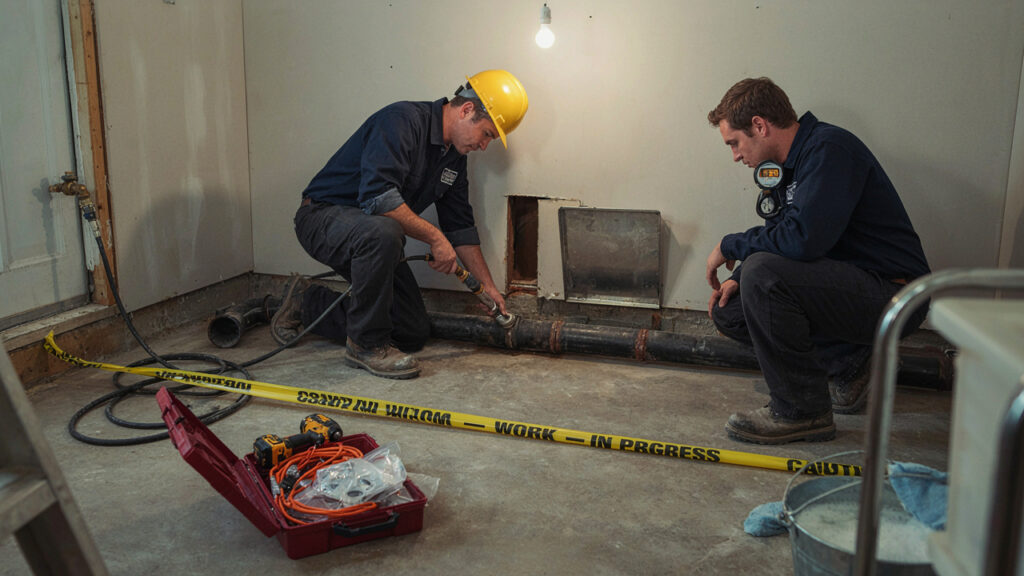
In case you own a property in Sydney which has a blocked or damaged drainage, you definitely would want to know the price estimates before calling the contractor.
The property owner looks for an indicative “price per metre” to compare quotes. Although the indicative market price per metre in 2026 ranges from $450 to $1,000 per metre for domestic pipes, the use of a per-metre price for your particular job will not provide an accurate estimate because a short pipe that needs repairing under concrete is necessarily much costlier than a long one in the open yard.
This guide provides you with current pipe relining costs in Sydney, the effect of pipe diameter and site accessibility on the price and other considerations.
How Much Does Pipe Relining Cost Per Metre in Sydney in 2026?
In Sydney, estimated prices for pipe relining in 2026 start at $450 to $1,000 for regular home pipes and $1,500 for large commercial pipes. Simple repairs would be on the low side, whereas complicated access points, extensive damage, and larger pipes tend to raise the costs.
These figures give the average pricing in the entire Sydney plumbing industry. The cost that will be charged to you will depend fully on the site situation.
The cost is calculated taking into consideration the total fixed operating costs like the use of heavy machinery, safety measures, and site preparation, plus the variable cost of the materials needed for the particular length of the pipe. Since the total fixed costs are constant irrespective of the scale of the project, the per-metre cost automatically lowers as the length of the pipes increases.
Sydney Pipe Relining Cost by Pipe Diameter
The physical size of the pipe will determine the volume of materials needed for the pipe lining repair process. Large pipes will need thick liners, more epoxy resin, and large installation equipment.
| Pipe Diameter | Typical Application | Indicative Cost Per Metre | Factors That Can Increase Cost |
| 100 mm | Standard residential sewer and stormwater branch lines. | $450 – $800 | Difficult access, heavy tree root intrusion, sharp bends. |
| 150 mm | Main residential sewer lines, light commercial drainage. | $600 – $1,000 | Deep trenches, multiple junction cut-outs, shared strata lines. |
| 225 mm | Medium commercial, strata mains, small civil applications. | $900 – $1,400 | High flow management, traffic control, structural reinforcement needs. |
| 300 mm+ | Industrial drainage, civil infrastructure, large mains. | $1,500+ | Specialised civil equipment, heavy bypass pumping, confined space entry. |
Note: The figures above reflect indicative Sydney market ranges for 2026. Actual pricing requires a site assessment.
For most Sydney residential connections, a 100mm pipe serves as the standard connection size leading into the sewer line. Due to the lighter weight of materials used in conjunction with standard jetting equipment capable of preparing the site, the prices remain at the low end of the scale.
As the pipe increases in size to either a 150 mm or 225 mm diameter pipe, which are typically found in older strata buildings located in the Eastern Suburbs or even in larger commercial developments in Parramatta, there is a significant increase in the surface area of the pipe. There is a considerable amount of resin used in order to fully saturate the heavy-duty felt liner.
Why Pipe Relining Cost Per Metre Can Be Misleading
A pipe relining quotation is usually never as easy as multiplying the length of the job by a certain price. The price charged per metre of the job may mask the fixed costs that are incurred to undertake the job properly.
Understanding what pipe relining cost is actually based on involves isolating the fixed costs from the variable costs involved.
Every legitimate relining project involves fixed stages:
- Initial CCTV inspection and diagnosis.
- High-pressure water jetting to clear blockages.
- Mechanical root cutting and pipe descaling.
- Equipment mobilisation and site preparation.
These basic expenses are incurred by the contractor irrespective of whether he lines two metres of pipe or twenty.
Let’s look at a real-life mathematical example with an assumed fixed cost of $1,800 and a variable rate of $450 per metre:
- Short Run (5 metres): $1,800 setup + ($450 × 5 m) = $4,050. The effective cost is $810 per metre.
- Long Run (20 metres): $1,800 setup + ($450 × 20 m) = $10,800. The effective cost drops to $540 per metre.
If you base your calculations on a “per metre” rate alone, you will misjudge your final bill. A firm that advertises itself for a cost of “$400 per metre” could very well be charging individually for the CCTV inspection, the root cutting, and the joint reinstatement, making their bill higher than the one who gives an all-inclusive quote.
How Access Affects Pipe Relining Cost in Sydney
The accessibility will dictate the number of labour hours necessary for the preparation of the pipe and the installation of the liner. The lack of easy accessibility will lead to the increase of the cost of the job.
In cases where the damaged pipe is lying beneath an open area such as a level yard, the construction machinery will be able to reach the area easily.
Costs increase under the following site conditions:
- Under Concrete Driveways and Slabs: In cases where there is no existing manhole, contractors will have to drill into the concrete to provide entry to the equipment.
- Deep Excavation: Houses on the steep blocks of North Shore have their sewer mains buried two to three metres below the surface. In the event that the contractor has to dig a launch pit to gain access to the pipe, the excavation will require shoring and excavators.
- Limited Access Entry: Limited access entry common in Inner West terraces will not allow the use of normal-sized inversion drums to reach the area where they can be used. The workers have to carry heavy and resin-coated liners and compressors manually inside the building or even through narrow side entries.
- Numerous Turns and Junctions: Re-lining of straight pipes takes little time; however, passing through many 45- or 90-degree turns will take more flexible liners and special inversion methods.
- Strata and Business Places: In high-density areas, traffic control, pedestrian safety barriers, and bypass pumping of the sewer flow from several flats will be necessary during resin hardening.
Other Factors That Increase Pipe Relining Cost
Beyond diameter and access, several technical variables routinely impact the final quote.
Pipe Condition and Preparation Time
The epoxy resin needs to adhere to the inner wall of the pipe that serves as the host pipe. In cases where the old terracotta drainage pipe is in very poor condition due to heavy degradation, calcification, or being clogged up by tree roots, it may take several hours of mechanical cleaning of the pipe prior to lining.
Junction Reinstatement
In the case of relining of the main pipe, the liner will be placed covering the entry points of the branch pipes connecting to the main pipe. The contractor has to send a robotic cutter to open up the connections so that water flows from the branch pipe to the main pipe.
Curing Methods
Natural curing (waiting for the resin to cure) is common practice but takes several hours. In the case where commercial establishments need the drain back in service immediately, there are devices that can use hot water, steam, and UV lights to cure the pipe liners in a matter of minutes.
What Should Be Included in a Pipe Relining Quote?
When comparing quotes from various Sydney builders, check the exact scope of work involved. Two quotes with the same total cost may provide completely different services and materials.
A complete quote must include the following:
- CCTV Inspection Before Installation: Assessment of the pipe condition and location of all junctions.
- Drain Cleaning: High-pressure jetting and root cutting to clean the host pipe.
- Materials Used: Specific kind of liner and resin (e.g., epoxy structural resin, silicate resin).
- Lining Method: Either inversion or drag-in.
- Reopening of Junctions: The exact number of branch lines that will be opened through use of a robotic cutter.
- Final CCTV Inspection: Video inspection of the cured liner to confirm compliance with AS/NZS 3500.
- Cleanup: All waste and spoils removed from the site.
- Warranty: Duration and details of the installation warranty.
When such elements are not included in the quotation, the contractor can categorise them as variations and include them in your bill.
Pipe Relining vs Pipe Replacement Cost
Many property owners enquire whether it is advisable for them to do nothing more than excavate the pipeline and fix it. This depends on the overall repair expenses, not plumbing costs only.
| Factor | Pipe Relining | Traditional Pipe Replacement |
| Excavation | Minimal to none. Uses existing access points where possible. | Heavy. Requires digging the entire length of the damaged pipe. |
| Surface Disruption | Preserves existing structures, gardens, and paving. | Destroys the surface above the pipe. |
| Restoration Costs | Zero or minimal. | High. Requires repaving, concreting, and landscaping. |
| Typical Duration | 1 to 2 days. | 3 to 7 days, including site restoration. |
| Cost Considerations | Higher upfront technical and material cost. | Lower material cost, but high excavation, labor, tipping, and reinstatement fees. |
When the damaged pipe is located under a cheap lawn, the expense of excavation and replacement is usually cheaper than relining the pipe.
However, when the pipe is situated under a tiled bathroom floor, a retaining wall structure, or a painted driveway, the cost of replacing the pipe involves demolition. The expense of renting a heavy excavator, paying Sydney landfill fees for the debris, and employing a concrete finisher for your driveway construction is more costly than relining the pipe.
When Pipe Relining May Not Be Suitable
Pipe relining is a very efficient form of repairs; however, it cannot solve all drainage issues. Each site we visit is inspected separately since putting the liner into an unstable drain system will not work.
Relining is generally not suitable for:
- Completely Crushed Pipes: In case the pipe is fully collapsed, the inversion drum will not be able to feed the liner through the obstruction. The pipe would need to be excavated and replaced.
- Major Belly: Perfect re-lining will conform to the existing grade of the host pipe. In the case that the ground subsidence makes the host pipe sag and retain water, the liner will sag too.
- Major Offset: In case tree roots or ground movement cause the pipe to break and become misaligned, it will not be possible to use a liner for bridging the gap.
In case one encounters such problems, we suggest undertaking localised excavation so as to fix the damaged section and, in some cases, reline the undamaged portion of the pipe.
How We Assess Pipe Relining Costs at Sydney No Dig Relining
With our service, you will not receive an estimated price through the telephone. Our technicians will know the full extent of the work to be done prior to quoting the price.
This process starts off with us inserting a CCTV drain camera into your system. We identify where the cracks, roots, and joints are. We establish the precise distance of the work needed to be done.
With an assessment of the physical limitations of the property and the condition of the existing pipe, we will determine the exact type of resin, liner thickness, and equipment necessary. After which, a quotation of the total cost will be provided depending on the scope of work. This way, you will know exactly what you are paying for after viewing the video inspection yourself.
If you are experiencing recurring pipe blockages at the moment, check out our complete pipe relining solutions.
What Does a Typical Sydney Pipe Relining Quote Look Like?
In order to comprehend how the site affects the prices, take into account the following two examples that are relevant at the moment for the Sydney property market.
Scenario A: The Straightforward Repair
In Penrith, there is a homeowner who has a sewage system which has been made up using terracotta pipes that have cracked joints with tree roots growing into it from three joints. It is located in a garden and the length of the pipe is 8 metres.
- Indicative Market Cost: $3,500 – $4,800 total. The easy access and lack of junctions keep the labour hours low.
Scenario B: The Complex Repair
An owner of an asset in the Eastern Suburbs has a 150 mm stormwater pipeline that is cracked, running exactly 8 metres below a structural retaining wall and a concrete driveway. There is heavy calcification and two junctions for downpipes on the pipeline.
- Indicative Market Cost: $6,000 – $8,500+ total. Despite being the exact same length as Scenario A, the larger diameter required robotic cutting for the junctions, heavy descaling, and complex access drove the price up. However, excavating the retaining wall and driveway would likely cost over $15,000.
Key Takeaway
To know how much pipe relining will cost, you have to go beyond the price per metre that is often advertised. With market prices at $450-$1,000+ per metre, the pipe diameter, access difficulty, and extent of damage will determine your quote.
When considering quotes, check what the company includes in their estimate. There should be no hidden costs such as the CCTV inspection, heavy drain cleaning, and robotic junction cutting. The best way to make an informed choice is by having your drain inspected by an expert.
If you think you have a cracked pipe, contact Sydney No Dig Relining. We’ll inspect the pipe, show you footage, and give you a transparent quote.
Frequently Asked Questions
How much does pipe relining cost per metre in Sydney?
Relining costs for pipe services in Sydney in 2026 depend on the diameter of the pipe, access, preparation and difficulty of repair works. The typical price range for domestic pipe relining is $450-$1,000/m. The price for commercial projects and those involving hard-to-access areas or excavations will be higher.
Is pipe relining cheaper than replacing a sewer pipe?
The cost of relining is more economical compared to replacing a pipe located under costly installations such as driveways, retaining walls, and tiled floors since relining circumvents the cost of demolition, excavation, soil removal and reconstruction that are normally involved in traditional replacement.
Does pipe diameter affect pipe relining cost?
Yes. Bigger pipes need thicker felt liners, more construction epoxy resin, and more machinery for the installation process. The process of relining a commercial drainpipe with a diameter of 225 mm is more expensive than relining a normal sewer pipe with a diameter of 100 mm.
Does pipe relining cost more under a driveway?
In cases where there is no existing access point, relining beneath a driveway is relatively expensive since the contractor will need to core drill through the concrete in order to gain access to the pipe. This process, however, is still far less costly than the other option: to demolish and lay a new driveway.
How much does a 10-metre pipe relining job cost?
An average 10-metre-long residential pipe relining project may cost between $4,500 and $8,000 based on the existing market scenario in Sydney. The total expense may depend upon the diameter of the pipes, the number of connections that require opening up again, the presence of roots, and the accessibility of the drains.
Do tree roots make pipe relining more expensive?
Heavy tree root penetration makes the job expensive because the plumber has to clean the pipe before lining it. When there are heavy hardwood roots that have blocked the drain, the team will spend many hours using high-pressure jetting and mechanical cutters to remove the scaling on the inside of the pipes.
Can every damaged pipe be relined?
Not at all. Relining can be effective for pipes that have partially caved in, but not those that have completely collapsed, structurally displaced or sagged to the point where they retain water. Nor can it solve the problem of pipes whose gradient has been affected by subsidence of the ground.
