
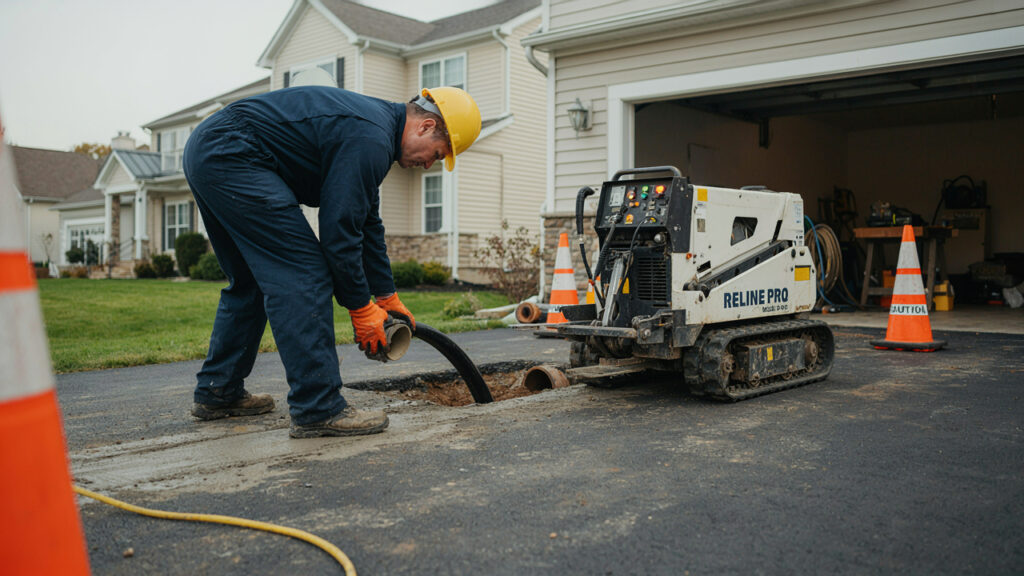
No-dig pipe relining means that there is less of an invasion when it comes to digging, removing earth, use of heavy equipment and resurfacing of the site because this method of fixing pipes does not dig up and expose the pipes for repair.
Nevertheless, no dig pipe relining is always the solution that causes no damage in all cases. Even though trenchless technology leads to a significant reduction in construction waste and fuel consumption during the transportation of the equipment on the construction site itself, the epoxy resins used along with the liners need a complex production process.
The most precise comparison between no dig pipe lining and conventional digging is by performing an overall life-cycle analysis. This will give you the true environmental cost, which depends on the depth of the pipe, the surface infrastructure that must be replaced, and the material used to solve the problem.
Is Pipe Relining More Environmentally Friendly Than Excavation?
Mostly for all residential and commercial properties in Sydney, trenchless pipe repair is environmentally more friendly compared to open trenching because there will be no use of diesel excavators, transportation of waste soil to the landfill site, and pouring of new concrete into the trench.
But there’s more to the environmental impact than just the work being done on-site. It all depends on the full life cycle of the repair process. We need to take into account how much carbon and how much waste there will be from the production of the pipe repair materials themselves, as well as the maintenance of them for many years to come.
What Is No-Dig Pipe Relining?
The technique used for repairing the underground pipes, which is called “no-dig” pipe relining or Cured-In-Place Pipe (CIPP) lining, requires no digging of the trench. Instead of replacing the damaged pipe by digging, a new one is formed inside it.
At Sydney No Dig Relining, our process follows a specific sequence:
- Inspection: This process involves the use of a high-definition drain camera inside the pipe to inspect for any cracks, root intrusion or collapsed portions of the pipe.
- Cleaning: High-pressure water jetting or robot cutters are used to clean up roots and scale to ensure that the host pipe is back to its original diameter.
- Liner Impregnation: The liner is soaked in a specially made epoxy resin.
- Installation: The liner is inserted into the host pipe.
- Curing: The liner is inflated to be in direct contact with the host pipe and then cured at ambient temperatures, hot water or ultraviolet light.
- Inspection: The CCTV camera is passed through the pipe to ensure that there are no flaws in the structure of the liner.
The result is a seamless, highly durable pipe housed within the original damaged pipe.
What Happens During Traditional Pipe Excavation?
Open-cut excavation has been traditionally employed in replacing old pipes. It involves the physical exposure of the pipe, and this entails the removal of anything constructed above it. The conventional process generally involves:
- Finding the accurate position and depth of the defective pipeline.
- Breaking up concrete, driveways, paving stones, or asphalt.
- Removing the spoil from the excavation to get access to the drainage pipe.
- Hauling the excavated spoil to a dump site using trucks.
- Chopping out the damaged clay, cast iron, or PVC pipe.
- Installing and joining the new PVC drainage pipe.
- Bringing in new bedding materials (such as blue metal or sand) to surround the new pipe.
- Filling back the trench and tamping down the soil.
- Replacing the surface by laying down new concrete or pavers.
The environmental effect is not just limited to that of the PVC pipes but extends much further. The major part of the environmental effect is from the use of heavy machinery, as well as the production of new concrete or paving surfaces.
No-Dig Pipe Relining vs Traditional Excavation: Environmental Comparison
In order to comprehend the difference, it is important to consider how each method works in relation to the site, materials, and local disposal infrastructure.
| Environmental Factor | No-Dig Pipe Relining | Traditional Excavation |
|---|---|---|
| Surface Disturbance | Minimal. Access is usually through existing inspection openings or minor access pits. | High. Requires destroying and rebuilding the surface directly above the pipe alignment. |
| Soil Movement & Spoil | Near zero. Soil remains in the ground. | High. Generates heavy spoil that cannot always be reused as backfill. |
| Heavy Equipment | Low. Primarily relies on a work vehicle, CCTV gear, water jetters, and a compressor/inversion drum. | High. Requires diesel-powered excavators, soil compactors, and concrete cutters. |
| Transport | Low. The crew and materials generally arrive in one or two light commercial vehicles. | High. Requires dump trucks to remove spoil and heavy rigid vehicles to deliver new aggregate, backfill, and concrete. |
| Construction Waste | Low. Minimal material sent to landfill, mostly liner offcuts and removed tree roots. | High. Broken concrete, old pipe fragments, and contaminated soil must be disposed of. |
| Material Impacts | Shifts to resin. Epoxy resins and textiles require chemical manufacturing and specialised transport. | Shifts to concrete and aggregate. Cement production is highly carbon-intensive. |
| Project Duration | Typically completed in a single day, reducing the prolonged presence of site machinery. | Often takes several days or weeks, extending noise, dust, and machinery operation. |
How Excavation Can Increase Environmental Impact in Sydney
Excavation transfers the environmental impact from the pipe itself to the immediate environment around it. With urban development like that seen in Sydney, excavation work for a trench leads to a domino effect on material usage and waste production.
The biggest contributor by far is construction and demolition waste. Waste from concrete, paving, and soil removal can be quite considerable. Putting this into context, construction and demolition waste in NSW made up 57% of total waste produced and 68% of all waste recycled for the period ending 2022-23, which included 12.7 million tonnes of waste in 2022-23 alone. In situations where one needs 20 metres of driveway torn up and replaced because of a broken pipe, that is an example of contributing waste to this category.
Additionally, there is high diesel consumption when working on an open-cut project. Fuel is consumed by the excavator machine while excavation is carried out. The dump trucks consume fuel carrying the clay and moist soil from the suburbs of Sydney to the waste sites at the western parts of the city.
The restoration of the landscape also brings about an added environmental cost. The trees may need to be removed or will be damaged by the roots due to the use of the excavator. The process of pouring concrete into the driveway means the introduction of a carbon footprint from the manufacture of cement.
Does Pipe Relining Have Environmental Downsides?
It is an extremely efficient process, yet it is not completely harmless to the environment. Claiming that a construction or repair technique is 100% environmentally friendly does not consider the nature of industrial production.
Environmental problems associated with pipe relining arise from the materials used in the process. Such liners are usually produced from synthetic fabrics such as polyester or fibreglass. Epoxy resins, which are used to impregnate the liners, are made from petrochemicals. Production of these resins is an energy-consuming process that comes with a substantial carbon footprint long before they enter Australia.
In addition, there is a need for strict controls in the transport and handling of these products. Resin products are packaged in industrial plastic containers. Upon reaching the site, mixing of the resin and the hardening of the liner needs mechanical energy. Whether by heating through the use of forced air, hot water, or steam, there will be a need for generators or compressors.
In the final analysis, a CIPP liner is a composite material. Towards the end of its lengthy lifetime of decades of service, an epoxy-soaked textile liner placed within a clay pipe is not easily separated and recycled, making it certain that it will eventually wind up in a landfill.
What Does Lifecycle Assessment Tell Us?
In order to do an effective comparison of such processes, engineers make use of Lifecycle Assessment (LCA). Lifecycle assessment is the technique by which one quantifies the environmental impact of a process from its beginning right up to the point of disposal.
As far as pipe repair is concerned, an LCA separates the impact into two parts:
- Installation impact: Emissions, fuel, and waste from the process of repairing the pipe.
- Whole-life impact: The embodied energy in the material and how long it will last until needing repairs.
Existing studies on the lifecycle of pipes have found that trenchless pipe rehabilitation is better than traditional open-cut replacement when it comes to global warming potential and fossil fuel depletion. This is due to the large decrease in diesel transportation and concrete replacement.
But then the equation changes when the excavation takes place on bare earth. When a broken pipeline is buried below the earth under a layer of just grass lawn and the excavator digs at a shallow depth without using concrete, then it becomes an environmentally friendly option to replace pipe relining.
Why the Sydney Context Matters
In the Inner West and Eastern Suburbs, houses stand very close to each other. Houses built on small terraces with small buildings that almost touch at the boundary have pipes running underneath living rooms, historic tiles, or small concrete paths. In such cases, excavation involves ripping apart the house and digging up either heavy clay soil or sandy soil.
On the North Shore and Northern Beaches, the already existing gardens and large native trees characterise the surroundings. The aged earthenware pipes found in these areas have the tendency to attract tree roots that are quite aggressive. The digging process often requires removal of mature trees to gain access to the damaged pipe.
In the context of these scenarios related to Sydney, relining does not even affect the surface. It allows us to fix a pipe which is infested with roots in clay and has a cast iron pipe with cracks without disturbing any brick or tree.
When Is Traditional Excavation Still the Better Option?
While trenchless construction is beneficial, excavation is still an engineering option. For the pipe relining process, a host pipe is needed that has a certain structural continuity in order to hold the liner until it is cured.
Traditional excavation is the appropriate choice when:
- The pipe has collapsed entirely: if the pipe has been flattened, a camera and liner cannot be passed inside the pipe.
- Bellies/Grade Problem: The liner takes the shape of the host pipe. Therefore, if the old pipe was sagging and holding standing water, the new pipe will continue to sag and hold water because it will have the same shape as the old pipe. Excavation will be necessary to lift the pipe.
- Misalignment: In case there has been some ground movement which has cracked the pipe into two pieces, which are out of alignment.
This means that lining a severely damaged pipe is an environmental waste of effort because no matter what the repairs may be, eventually the work will have to be done using the trenchless method. Even if it costs extra money, the right thing to do is do it right the first time.
To explore a detailed breakdown of how these methods compare on performance and pricing, you can read our comprehensive guide on pipe relining vs excavation and which drain repair method is actually better.
How to Choose the Lower-Impact Repair Method
Choosing the right method requires data, not guesswork. A practical decision framework looks like this:
- Inspection first: Never dig or reline without the CCTV drain camera inspection. You have to identify the actual cause of failure.
- Suitability assessment: Identify whether the pipe has sufficient strength to serve as a host for the resin liner. Check its gradient and alignment.
- Surface mapping: What lies above the pipe? Grass? Reinforced concrete driveway? Retaining walls?
- Look at the cost during the pipe’s life: If the pipe is buried beneath concrete, excavation involves heavy equipment, diesel-powered trucks, disposal fees for waste material, and new concrete. In this case, relining will definitely have less environmental impact than excavating. On the other hand, if the pipe is covered by only a thin garden strip, the environmental cost of a fast excavation might be equal to that of the chemical liner.
What Does This Mean for Sydney Homeowners and Property Managers?
From a homeowner, strata manager, or commercial operator’s point of view in Sydney, environmental issues will inevitably be coupled with economics and ease of execution of the work at hand.
In essence, all factors that increase the carbon cost of an excavation project—use of heavy equipment, transport of spoil, demolition of concrete, and transportation of material—will also increase the economic cost and time needed to complete the job. An excavation project that needs three dump trucks and concrete pours is environmentally damaging, highly disruptive, and costly to undertake.
Property managers can avoid having to shut down the facility, maintain open driveways, save money on costly landscaping, and reduce the impact of their building maintenance operation by not damaging the structure.
To Sum Up
Where the environmental effect of no-dig pipe relining is compared to conventional digging in Sydney, it is found that trenchless technology has a less environmental effect than the latter method. This is due to the fact that the method doesn’t involve digging, which would otherwise lead to heavy diesel exhausts, spoil dumping and concrete waste.
Although the epoxy resins and liners leave an environmental footprint, the environmental cost of the cycle is less because relining reduces the need to demolish and replace driveways, pathways, and trees. This, however, is not enough. Relining will be sustainable only if it resolves the drainage problem once and for all.
In case of persistent blocked drains, problems caused by roots of trees, and possibly pipe problems, it is important to know exactly what is going on beneath the ground. Reach out to us at Sydney No Dig Relining to conduct a CCTV inspection and help you choose the best solution for your needs.
FAQs
Is pipe relining more environmentally friendly than excavation?
Yes, but only to some extent. Pipe relining does not require the use of heavy earth-moving equipment, the disposal of large quantities of excavated soil at dumpsites, and the manufacture of new concrete for the repair of driveways. However, it has its own environmental impact.
Does pipe relining create less waste than replacing a pipe?
Yes, traditional pipe replacement produces a lot of construction debris, like excavated soil, broken concrete, and the old damaged pipe. However, pipe relining creates zero construction debris because the old pipe is still there, and nothing changes above the surface.
What are the environmental disadvantages of pipe relining?
The major disadvantage of the process in relation to the environment is the production of materials. Pipe relining requires epoxy resins made using petrochemicals and artificial textiles. The materials need much chemical processing and energy in their production and are hard to recycle at the end of their life cycle.
When is excavation necessary instead of pipe relining?
Excavation will be required in cases where there is total collapse of the pipeline, severe “belly” (bad gradient) and where the joints are not correctly aligned. This is because the lining is formed by the host pipe; hence, it cannot correct any serious defect.
How much excavation is avoided with pipe relining?
Pipe relining will eliminate all of the trenching needed in the case of conventional pipe replacement. We usually only need one tiny entry point that may even be an existing inspection point, through which we can fix extensive lengths of pipe underground.
