
There are few things more gut-wrenching for a homeowner than seeing sewage back up into their bathroom. You can practically visualise the backhoe excavating your perfectly maintained yard as well as razing your driveway to make way for some work.
What if there was another way to fix a broken pipe?
Be it in front of the famous sail-shape structure of the Sydney Opera House or in the peaceful and green surroundings of the Hills District, plumbing emergencies do not discriminate. When there is an issue with your buried pipes, you are left with two choices when it comes to the process of fixing them.
It is not uncommon for our clients at Sydney No Dig Relining to contact us in their desperation about plumbing issues, searching for the most efficient way to deal with the problems. For those who need to know the differences, here is an elaborate guide.
Let us go through it without digging even a small hole in your backyard.
The Reality of Broken Drains in Sydney
The tough weather conditions in Australia, along with the fast-growing nature of its roots, prove to be a constant struggle for underground plumbing. The thirsty fig and gum trees continually try to find water and manage to enter even the tiniest cracks in the old pipes. As a result, the roots expand, causing clogging and major damages.
Once upon a time, there wasn’t any other way but to excavate the whole piping system. However, today, everything is totally different. When you look at pipe relining vs excavation, one can see how technology has tipped the scales in favour of the homeowner. Nevertheless, to make a good decision, one should know about both methods well.
The Old School Approach: Traditional Excavation
Traditional excavation means precisely what it suggests. The plumber brings in either heavy machinery or even a team carrying shovels to excavate a trench along the damaged pipeline. This is followed by the replacement of the faulty sections with new piping.
How Long Does Traditional Pipe Replacement Take?
When trying to determine how long traditional pipe replacement takes, the answer is not immediate, since the time frame will depend on the depth of the pipe and the length of the area that needs to be replaced. It could range anywhere from three days to more than a week.
If the pipe passes under concrete, then the workers have to use additional time to cut and jackhammer through the concrete to get to the ground.
The Problem with the Mess
The downside with this procedure is that it could cause a lot of destruction. Damage to driveways, landscaping, and floor structures is inevitable. Should the pipe being broken be located under your favourite rose garden, newly installed driveway, or bathroom tiles, then everything gets messed up.
Key Takeaways for Excavation:
- Requires heavy machinery or extensive manual labour.
- Destroys the surface area above the pipe.
- You carry the burden of restoring your landscaping and concrete afterwards.
The Modern Fix: Trenchless Pipe Relining
In contrast to traditional trench methods, trenchless technology restores the damaged pipeline from inside, thus giving rise to an “inside-out” solution.
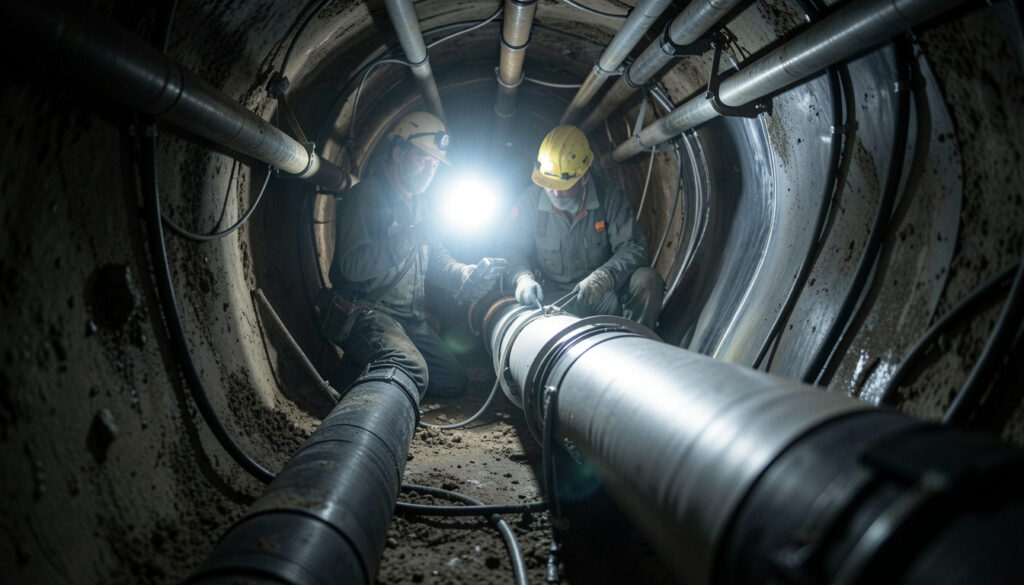
Being drainpipe relining Sydney specialists, we first perform an inspection of the pipe with the help of advanced camera equipment. Then, using a high-pressure water jetter, we remove all the clogs. When the pipe is cleaned, our team places a specially made liner, which is covered with epoxy resin, into the damaged pipeline. Inflation of the liner by means of an internal bladder makes it tightly bond with the inner surface of the old pipe.
After that, when the resin gets hardened, the bladder is taken away and the pipe restoration process is completed.
Can You Reline Under House Slab?
One of the biggest strengths of the technique is that it offers great flexibility. Many people wonder if we can reline under the house slab. And the answer is yes because all we need is an entry point through which we can pass the liner since the pipes may be deeply embedded in the concrete foundation, pool, or retaining wall structures.
In an intriguing twist, this technological advancement is not a trend that will soon fade away. According to Wikipedia, Cured-in-place pipe (CIPP), which was invented back in 1971, has been tested extensively for over 50 years now.
Pipe Relining vs. Digging Cost Comparison Sydney
This is what ultimately matters most to property owners. Here is a realistic pipe relining vs digging cost comparison Sydney residents should be aware of.
On the face of it, the plumber could give you a more affordable rate per metre for trenching than the trenchless epoxy pipe repair. However, relying on the plumber’s quotation alone is a potentially deceptive trap.
In the case where you dig, the cost of plumbing will include not only the replacement of the pipe but also refilling the pit dug out with soil. The cost of the hidden repairs is not included.
- Hiring a landscaper to replace your dead grass and garden beds.
- Paying a concreter to pour a new section of driveway.
- Hiring a tiler to fix your bathroom floor.
- Paying council fees for road or nature strip closures.
By including these costs, the process of excavation becomes very expensive. Using our trenchless services, the cost estimate provided to you will be the final one. There will be no additional costs for the landscaping since we leave your property just as we received it.
The Green Factor: Environmental Impact
Today’s customers are more environmentally conscious, thus encouraging us to think about the environmental consequences of not digging and digging. The removal of existing pipes is very wasteful, requiring the use of diesel-driven heavy equipment and the creation of a tremendous amount of waste material.
According to Statista, the construction and demolition industry creates millions of tonnes of core waste annually in Australia alone. Thus, tearing up concrete and getting rid of clay pipes adds to the already considerable problem of filling up landfills.
Zero waste is achieved by trenchless rehabilitation of the old pipe below ground, which keeps all old materials from ending up in landfills, prevents the use of diesel excavators and reduces the environmental impact of the repair process.
Key Takeaways for Environmental Impact:
- No heavy machinery emissions.
- Zero concrete or terracotta waste sent to local landfills.
- Preserves established tree roots and native vegetation.
Built to Last: Durability and Lifespans
It is natural to wonder if a resin liner is really as strong as a thick PVC pipe. The short answer is yes. In fact, it is often stronger.
The epoxy resins that are currently used for trenchless rehabilitation have strength similar to that of concrete. They create a seamless pipe lining without any joints where the roots could penetrate. Thanks to such strong design, we can safely provide a 50-year warranty on the pipe lining.
Once the resin is fully cured, the newly relined pipes become incredibly resistant to chemical corrosion, earth movements, and roots. Not only will this provide you with an immediate solution but will last for decades to come. When you use Sydney No Dig Relining, you are guaranteed fifty years of peace of mind.
When is Excavation Still Necessary?
At Sydney No Dig Relining, we love the trenchless technology approach, and honesty requires us to admit that it is not a panacea for all plumbing problems.
So, when is excavation still necessary?
- Pipe Crushed: In a situation where a pipe has been completely crushed by the soil around it, there is no longer any structure left that can accommodate a liner.
- Severe Shifting: Where the earth has moved so much that it has broken the pipe and moved it a few inches off-centre, a liner cannot pass through that big opening.
- Piper Belly: If the pipe is sagging and has created a “belly” where water gets trapped, re-lining the pipe would just create a new liner on the pipe that is still collecting water.
In these specific scenarios, getting the shovels out is unavoidable. However, for cracks, leaks, root intrusions, and partial breaks, trenchless remains the superior choice.
Comparing Your Options
If you are a visual learner, here is a straightforward breakdown of how the two methods stack up against each other
| Feature | Trenchless Pipe Relining | Traditional Excavation |
|---|---|---|
| Project Duration | Usually completed in 1 day | Ranges from 3 to 7+ days |
| Surface Damage | None (No digging required) | High (Destroys gardens & concrete) |
| Total Hidden Costs | None | High (Landscaping & rebuilding) |
| Lifespan | 50+ years | 50 years |
| Root Resistance | Excellent (Seamless interior) | Moderate (Joints can fail over time) |
| Eco-Friendliness | Very High | Low (Requires heavy machinery) |
Making the Right Call for Your Property
Plumbing repairs can be a nightmare even without the added concern of the bulldozers ruining your weekends. With everything from the facts, the prices, and the guarantees pointing to one definite thing, it is only logical to conclude that trenchless pipe repair is the most intelligent, efficient, and cost-effective choice, provided that the pipes have not been totally destroyed.
If you have reason to believe that there are root issues, leaks, or constant blockages, do not wait until your pipe breaks down completely; contact professionals for a camera inspection and find out if your property could benefit from trenchless repair.
Are you ready to stop those pesky pipes for good with no mess at all? Request a quote, and let us show you why we are the trusted local experts.
Frequently Asked Questions
How much does pipe relining cost in Sydney?
The costs will be contingent upon the size of the pipe, as well as the extent of the damage. However, considering that trenchless repair avoids any costs for concrete and landscaping repairs, it would normally be cheaper.
Can tree roots penetrate a relined pipe?
Regular pipes feature joints that allow the roots to get in through. However, a relined pipe would be one solid piece of hardened epoxy resin and would be entirely protected from the roots.
Does pipe relining reduce water pressure?
The resin liner shrinks the inner lining of your pipe by just a few micrometres to give you an ultra-smooth inner surface for better efficiency in the passage of water without losing any pressure at all.
How long does the pipe relining process take?
Residential drain pipe relining projects in Sydney get done in one day from start to finish. We come in, inspect the situation, clean it up, install the liner, cure it and get you back to business before nightfall.
Are all plumbing pipes suitable for relining?
We can reline PVC, clay, cast iron and concrete pipes. As long as your pipe maintains its roundness, we can fix it with our trenchless technology.
