
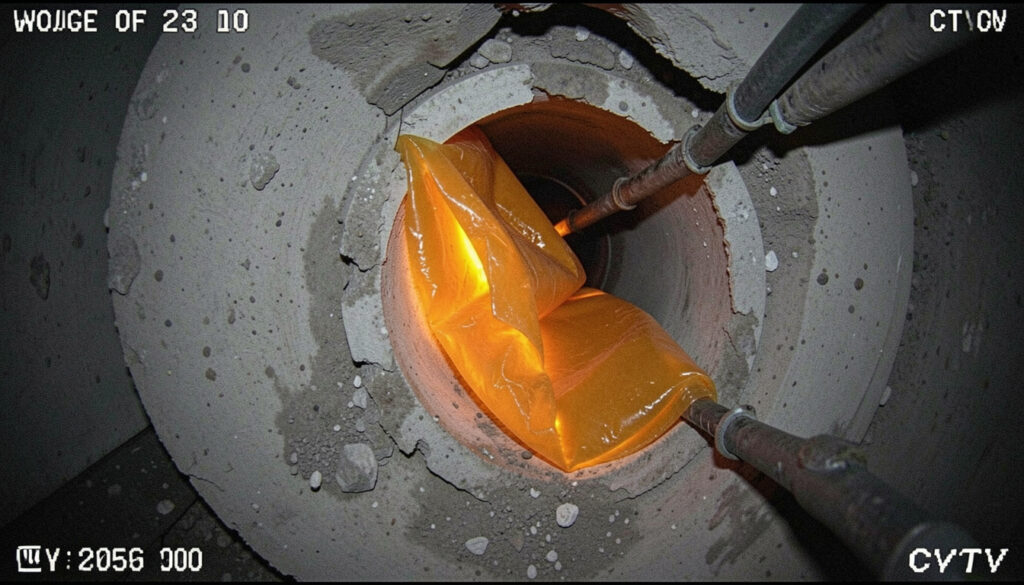
Can a pipe relining company mend a fully collapsed pipe? Unfortunately, the answer is often no. The pipe would have to be excavated and replaced if it has completely crushed, flattened, or folded in on itself to the point where there is no room for the epoxy lining to pass though. The structural integrity of the pipe has failed in these instances, and the old pipe must be excavated and replaced.
However, many Sydney homeowners are being misled into thinking that their pipes have ‘collapsed’ but in reality, they may be heavily fractured, disjointed, or blocked beyond reasonable cleaning due to the aggressive tree root intrusion. Such damaged pipes can actually be repaired using our trenchless pipe repair services.
Using high pressure water jetting combined with robotic cutters operators can remove the debris, reshape the damaged pipe section and install a structural liner, forming a new smooth pipe within the old one. In short, drain camera inspection is the only reliable method of establishing whether the pipe has completely collapsed or can undergo such a rehabilitation process.
The Difference Between a ‘Broken’ Pipe and a ‘Fully Collapsed’ Pipe
When a plumber tells you that your sewer or stormwater line is damaged, it’s important to know what kind of damage it is. A broken pipe and a collapsed pipe require very different solutions.
At Sydney No Dig Relining, we see hundreds of damaged pipes every month. Residents of the Northern Beaches and the Hills District often think the worst when their drains begin to back up, but structural damage can take many forms.
1. Cracked and Fractured Pipes
This is by far the most common problem we see in Sydney older properties. Ground movement, heavy rain and just age can lead to this type of failure. As long as the pipe is still roughly circular in shape, then pipe relining is a perfect solution.
2. Offset Joints
Older terracotta clay pipes were laid in short lengths. As the earth shifted, these short lengths of pipe can become out of line with each other. This is commonly referred to as an offset joint. An offset joint can be repaired by installing a transition liner which bridges the offset, however this is only possible if the offset is small.
If the offset is so great that the two pipes have slid completely past each other, the liner cannot span the gap as this would create a permanent obstruction.
3. Missing Pipe Sections
Sometimes, at the bottom of an old pipe the entire bottom section rots out leaving a trench of bare soil. Surprisingly there is a way to reline such a pipe. As long as surrounding dirt has not eroded away leaving a huge cave, an inversion liner can be forced up and out against the soil to cure a new tunnel.
4. The Fully Collapsed Pipe
A true collapse occurs at the point where the weight of the soil or other elements on top of the pipeline causes the destruction of the structure which makes the pipe lose its shape. In case there is a completely collapsed line, a simple CCTV inspection will run into a concrete mess of dirt and broken rocks. The reason for this is that there is no cavity available for pulling or inversion of a liner.
When Pipe Relining Works (And When It Requires Digging)
To help you understand what you might be looking at on a plumber’s monitor, here is a description of some common pipe defects plus an explanation of how they are repaired.
| Damage Type | Visual on CCTV Camera | Recommended Solution |
|---|---|---|
| Hairline Cracks | Thin dark lines running along the pipe wall. | Pipe Relining |
| Tree Root Intrusion | Fibrous masses blocking the camera’s view. | Jetting, Robotic Cutting, then Relining |
| Minor Offset Joint | A slight ‘step’ between two pipe sections. | Pipe Relining |
| Major Offset / Dropped Pipe | A complete vertical disconnect between pipes. | Excavation (Targeted) |
| Missing Pipe Floor | Exposed soil visible at the bottom of the pipe. | Pipe Relining |
| Fully Crushed Pipe | Flattened walls, total blockage by soil/rocks. | Full or Sectional Excavation |
What Our Sydney CCTV Inspections Actually Reveal
You should never agree to major plumbing work without seeing the evidence for yourself. A professional CCTV drain inspection makes the work to be done underground clear as day.
When inspecting your property, whether that be a historic property in the Inner West or a commercial site in the Sydney CBD, we utilise a strict diagnostic method.
The Diagnostic Process
| Step | Action Performed | Why We Do It |
|---|---|---|
| 1. Initial Camera Pass | Feeding a diagnostic camera into the access point. | To identify the immediate location of the blockage or damage. |
| 2. High-Pressure Jetting | Clearing sludge, roots, and debris using 5,000 PSI water jets. | You cannot accurately assess a pipe wall if it is covered in mud or roots. |
| 3. Structural Assessment | Measuring the percentage of pipe ovality (how squashed it is). | To confirm if an epoxy liner can safely inflate without snagging. |
| 4. Precise Locating | Using a sonde above ground to track the camera’s exact position. | If we have to dig, we know precisely where to break ground, minimising damage. |
The “Hybrid” Solution: The Industry Secret
There is a scenario that many traditional plumbers won’t tell you about. What if you’ve got 20 metres of damaged pipe running underneath your drive but only one metre has completely failed. You do not need to dig up the entire 20 metre stretch.
We often use a hybrid repair method and find the collapse spot, excavate this spot, take away the crushed part of your pipe and replace it with PVC one. Next, we use the trenchless method to reline the other 19 metres of your pipe
This method helps to avoid the expensive landscaping and concrete restoration and provides a long-lasting repair.
Local Factors: Why Sydney Pipes Fail
The geography and history of Sydney are significant factors in the cause of pipe failures. Getting to know the ground beneath your suburb is key to understanding the potential issues with your drains.
The Eastern Suburbs and the Inner West were built on long ago, and many properties still retain their original terracotta clay sewer lines. These older properties had all the infrastructure installed necessary to allow the area to flourish, including sewerage systems. However, these terracotta pipes are very delicate and cracked easily, and although they may have been sufficient in the 1950s, traffic vibrations and shifting earth can cause them to break completely.
The North Shore and Sutherland Shire: This region has an abundance of mature trees. The roots love to grow through the sewer pipes. The roots absorb moisture and nutrients from the drain. A tiny thread of a root can grow to a thick trunk inside the pipe. The growth puts enormous pressure on the walls of the pipe which eventually breaks the sewer pipe.
Sydney Water policy on tree roots indicates that customers are responsible for the lateral line. The lateral line is the pipe connecting the house to the main sewer line. Unless you have a commercial development, the cost of repairing the damaged lateral line due to the roots is entirely borne by the homeowner.
How Strong is a Relined Pipe?
If your pipe is badly cracked but still mostly intact, you may be wondering if a resin liner would be sturdy enough to hold the earth above it in place. The epoxy resins and felt liners we use cure into a composite material that is far stronger than an ordinary patch job or thin layer of paint.
It is a new pipe within a pipe. Once cured, the new pipe is resistant to root intrusion, shifting of the ground, and is impervious to chemicals. In fact, third party testing has shown that an epoxy-relined pipe can withstand twice the pressure of standard PVC piping.
Environmental and Strata Considerations
A broken pipe is a headache for strata managers and commercial property owners. Digging up a driveway at a complex in Ryde or Parramatta is bad news and causes endless logistical issues for everyone from other residents to the local council and is absolutely detrimental to the environment.
When a pipeline is on the point of collapse but can be relined, prompt action can prevent huge costs and inconvenience. Relining causes little or no spoilage to go to landfill, doesn’t need big machines to excavate the pipeline, and can often be completed in a day.
When to Call in the Experts
If you’re having constant drain blockages, slow running sinks or smelly drains in your yard, your pipes are trying to talk to you. The issue is a symptom; structural damage is usually the cause.
By waiting for the pipe to collapse flat we can turn a simple relining job into a costly excavation. The earlier we can snake a camera down the drain the better our chances are of saving your existing infrastructure.
Key Takeaway
So, is it possible to restore a pipe that is completely crushed or flattened? Unfortunately, while trenchless technology is amazing, it can’t break the laws of physics!
If it’s completely smashed, some excavation will be required, but in most cases, the ‘ruined’ pipes we see in our Sydney service are still structurally intact enough that we can utilise trenchless methods and restore them without excavation: whether they have cracks, missing floor sections, or have had roots intruding.
The difference between a quick, non-invasive repair and a large excavation bill is often determined by the time it takes. Don’t wait until it’s too late.
If you’re dealing with difficult blockages or believe that your pipes may be at risk, Sydney No Dig Relining should be called upon straight away. We can utilise our CCTV cameras to show you exactly what is going on below the surface in real time and help you decide the best course of action for a permanent resolution.
Frequently Asked Questions
How do I know if my pipe has collapsed or just blocked?
The only way to be certain is to have a CCTV drain inspection. Simply plunging or jetting will clear it momentarily, but if the pipe has collapsed, water will simply shoot back out and mud or stones will be pumped back out by the plumber’s eel.
Does Sydney Water fix collapsed sewer pipes?
The only works for which Sydney water is responsible are the main sewer lines. The pipes on a householder’s premises from the house connection to the boundary are the responsibility of the householder. If they collapse, the costs of repairs are for the householder to pay.
Can you push a pipe liner through a crushed pipe?
No. An inversion liner needs room to unroll and inflate. It can’t get unstuck if the pipe was completely crushed by the weight of the ground above. The crushed part will have to be excavated if it gets completely collapsed.
How long does pipe relining last in Sydney soils?
When properly installed with high-quality epoxy resins, pipe relining can provide more than half a century of reliable service. It is highly flexible, able to respond to ground movements characteristic of Sydney’s reactive clays, and creates a seamless barrier that prevents invasive roots from penetrating the host pipe.
Is pipe relining cheaper than excavation?
If the pipe runs underneath a garden bed it may be slightly cheaper to excavate however if the pipe runs under your driveway, a tiled bathroom, a retaining wall or a council footpath it will be substantially cheaper to have the pipe relined rather than excavated and reinstated due to the prohibitive cost of reinstating these type of works.
Can tree roots actually crush a PVC pipe?
While superior to older clay pipes in many ways, even high-pressure PVC is not safe from the damaging effects of mature tree roots seeking to get inside the pipe by growing alongside it and then wrapping around the pipe, crushing it. By relining a PVC pipe you are essentially reinforcing it.
